Self-Influence
Before influencing others, do you really have influence over yourself?

A warm welcome to everyone who has recently joined Letters from Andy Ayim. I am glad you are here. We will be announcing our coaching session competition winner on 1st April over on Instagram and LinkedIn, so keep an eye out.
Last week I facilitated a masterclass.
As we approached the end of our time together, I could feel the weight in the room. Not tension. Weight. The kind that comes when a group of people are genuinely sitting with something.
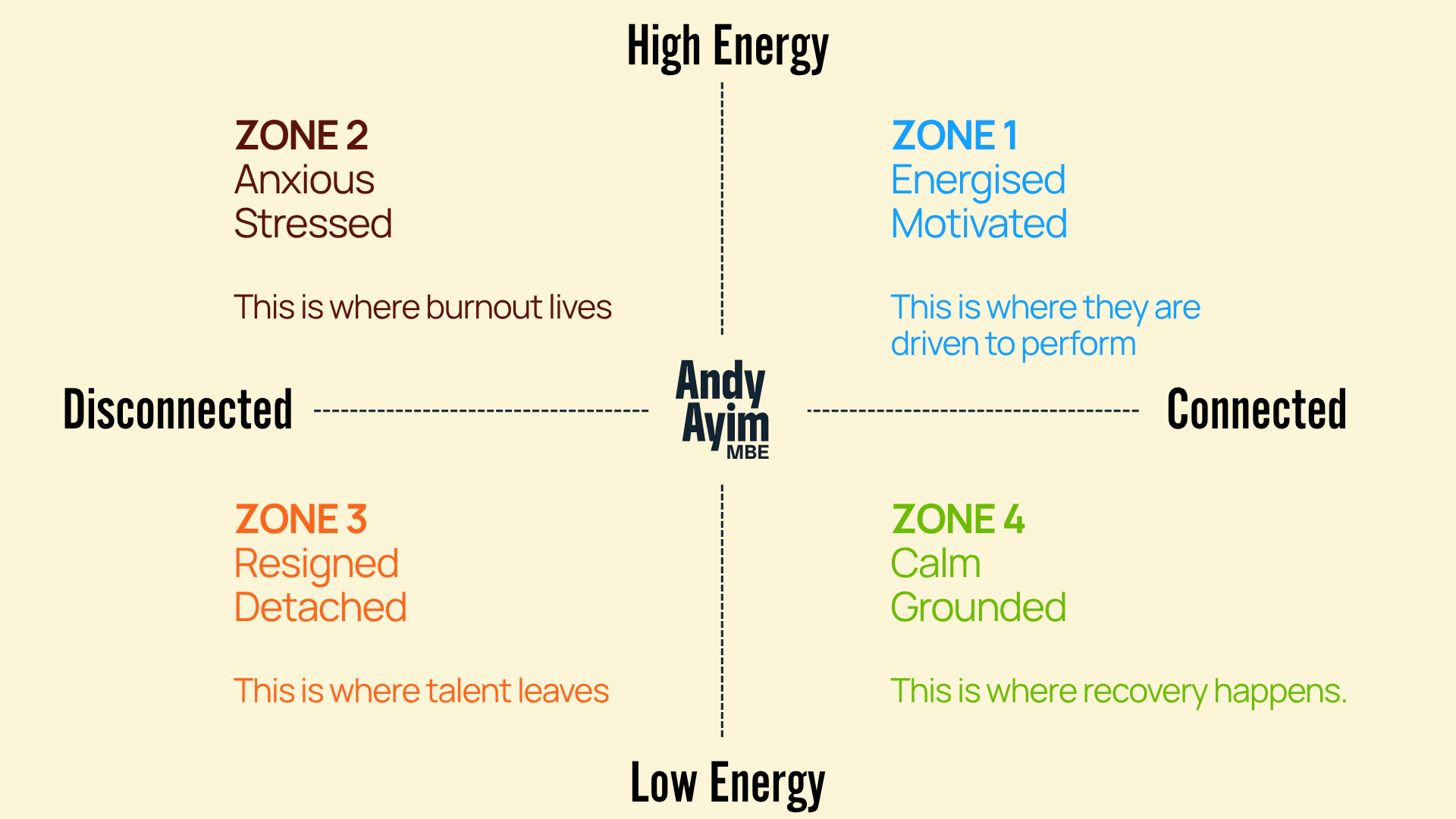
I had taken them through the Team Emotional Audit framework, which maps the emotional state of a team across four zones. I asked them to identify what zone their team was currently in. Then I paused and asked the follow-up question I always find more revealing.
“And what zone are you personally in right now?”
It became an individual exercise. Heads down. Quiet thoughts. People were still in that space when I invited them into my closing question.
“Based on our time together today, what surfaced for you, and how are you feeling?”
The silence that followed wasn’t awkward. It was honest. The kind of silence that tells you the room is working.
Then one participant, courageously, chose to share.
“It’s given me some food for thought,” she said. A pause. “Firstly, about what zone I am in, and therefore where I need to transition from, before I am in a place where I can genuinely support my team in shifting their emotional tone. Thank you for this.”
The room didn’t respond with noise. It responded with more silence. The kind where you can feel everyone quietly applying what was just said to themselves.
She had taken personal responsibility for her own inner state as a precondition for leading others well. I loved that sense of ownership, honesty and vulnerability. I was cheering her on - on the inside.
But there was another moment in that room that stayed with me longer.
A woman who has been in her organisation for almost thirty years raised her hand. She wasn’t celebrating a breakthrough. She was sitting with a question that was clearly causing her real discomfort.
“My concern,” she said, “is that the organisation is changing. There’s a new generation. A different way of working. And I’m wondering if I can adapt. I’m wondering if I’m still relevant.”
The room went very still. This one felt more tense than the last silence.
What she was naming wasn’t a leadership problem. It was an identity problem. After three decades of knowing exactly who she was in that context, the context had shifted. And she was left asking: if the organisation changes, who am I?
I don’t know if her redundancy came this week, or if it will come next month, or if it will come at all. But I know with absolute certainty that what she was feeling in that room, that erosion of identity, that fear of irrelevance, that question mark over her own adaptability, is exactly what lands on someone when they’re told their role is being eliminated after twenty or thirty years.
It’s the same weight. Just arriving differently.
That moment is why I want to speak directly to you, if you’re reading this and you’ve just received that news. If you’ve been made redundant after decades in a large organisation. If the identity you built, the routine you knew, the peer group you belonged to, all fell away in a conversation that lasted twenty minutes.
This isn’t easy. Redundancy after two decades feels like loss, not opportunity. That’s real and valid. Sit with that for a moment. Don’t skip it. The mortgage, the kids, the flexibility, the friendships, it all matters. It is a different type of mourning.
But before you can move others, you have to move yourself first. And that starts with honest questions.
Am I burnt out, and do I need space to recover before I can show up well for what’s next?
Are there strengths I am underusing, or patterns I have been avoiding, that are quietly shaping how I see myself right now?
Do I protect time for genuine reflection, to ask what I did well, what I could do better, and what I would do differently?
These are not comfortable questions. But they are honest ones. And honest questions, asked in private, are often the beginning of real change.
Because here is what I have come to believe about moments like these. The disruption is rarely the real story. The real story is what you choose to see when the dust settles.
What is ahead of you, even now, even in the uncertainty, is an opportunity. Not a consolation. An actual opportunity worth being excited about.
The questions that help me reframe in these moments are ones I return to often:
If I detached my identity from my job title, what strengths would remain?
What have I always been intrigued by that I have never given myself permission to pursue?
What would it look like to fulfil my potential, not just replace my income?
What would make work feel like play?
The biggest barrier is rarely a lack of options. It is a lack of permission to explore them. Fear of what others might think, or the weight of financial pressure, can keep us anchored to a path that no longer fits.
But transitions, however painful, have a gift inside them. They force the question of who you actually are when the structure falls away.
The woman in my masterclass found her moment in a facilitated room, sitting with the question before the disruption arrived. The person I spoke to this week is finding their way in open water, learning to move forward in the disruption itself.
Both are doing the same work. They are building influence over themselves before they can exercise it over anything else.
That is self-influence. And it is where everything else begins.
So as you close out this week, one question worth sitting with.
Be selfish for once. When you reflect on your identity, are you where you want to be? If not, find some quiet time to walk through the questions outlined above.
Love & Light,
Andy Ayim MBE